

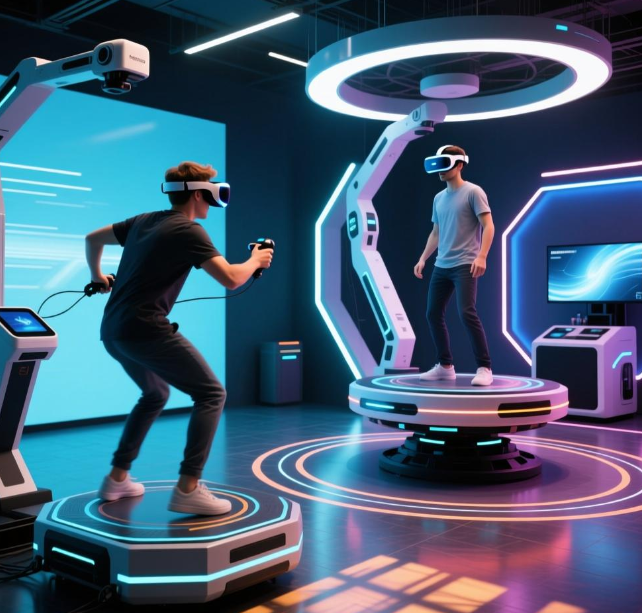
In the entertainment industry, six-degrees-of-freedom (6DoF) platforms are primarily used for
motion seats, motion-sensing games, and VR experiences. By simulating six degrees of freedom in space,
they provide users with an immersive experience.
Motion Cinemas and Theme Parks: It's a standard feature of 4D/5D motion cinemas. The seats can mimic
falling, shaking, and other special effects based on the film's plot, combined with environmental effects to
create a fully immersive viewing environment. Projects like the LeRen Wharf Flying Cinema utilize this
technology.
Motion-Sensing Games and VR: In motion-sensing games such as racing and flying, the platform can
simulate realistic driving sensations like acceleration and steering. VR devices like PICO also utilize 6DoF
technology to make virtual concerts and game experiences more realistic.
Six-Degree-of-Freedom Motion Platform: Reshaping Entertainment Experiences with Immersive Revoluti
on
In the rapidly developing wave of virtual reality (VR) technology, the six-degree-of-freedom (6DOF) moti
on platform is becoming a core device for pushing the boundaries of entertainment experiences. By
precisely simulating translational and rotational movements in three-dimensional space, this technology
is redefining the industry standards for immersive entertainment.
I. Technical Principles and Immersive Logic: The six-degree-of-freedom platform achieves complex move
ments of X/Y/Z axis translation and pitch/yaw/roll rotation through electric or hydraulic drive systems.
Its core value lies in breaking the "sensory disconnect" problem of traditional VR. When players wear VR
equipment to experience a roller coaster game, the platform can synchronously reproduce the feeling of
weightlessness and centrifugal force, creating a unified neural feedback of visual, vestibular, and proprio
ceptive sensations. This multimodal integration significantly reduces the incidence of motion sickness
and increases the average immersion time by more than three times.
II. Industry Application Scenarios
Theme Park Revolution
Shanghai Disneyland's "Soaring Over the Horizon" project utilizes a six-degree-of-freedom platform, com
bining 2.5-meter travel motion seats with an 8K panoramic screen and 4D effects, achieving an average
annual experience volume of over 5 million visitors worldwide. Tokyo TeamLab Planets uses this technol
ogy to create a "borderless" interactive space, setting a record of over one million US dollars in daily reve
nue.
Esports Experience Upgrade
Space simulation games such as "EVE: Valkyrie" use customized motion seats to control the accuracy of
G-force changes to within ±0.1 m/s². Professional players report that this equipment increases tactical
decision-making speed by 40%, giving rise to a new category of "motion esports."
Home Entertainment Evolution
Sony's PSVR2's accompanying motion seat adopts a modular design, using AI algorithms to convert ga
me data into motion commands in real time. Tests show that its "Gran Turismo 7" achieved an immersio
n score of 9.2/10, driving a 300% year-on-year increase in home VR equipment sales.
III. Industry Ecosystem Restructuring: This technology is driving the formation of a new ecosystem of "h
ardware + content + services." On the hardware side, Chinese manufacturers have captured 60% of the
global mid-range market; on the content side, engines like Unity have added 6DOF (six degrees of freed
om) physics simulation modules; and on the service side, the cost of converting a single theater into a
motion simulator has dropped to 500,000 RMB, shortening the investment payback period to 8 months.
With the maturation of 5G and cloud rendering technologies, six-degrees-of-freedom platforms will dev
elop towards lightweight and intelligent designs. It is projected that by 2028, the global entertainment
application market will exceed $12 billion, completely reshaping the physical limits of human entertainm
ent experiences.