

The hollow-shaft servo electric cylinder is a high-precision, customized servo electric cylinder that exhibits distinct differences in both structure and performance compared to traditional, standard electric cylinders:
Comparison of Core Parameters
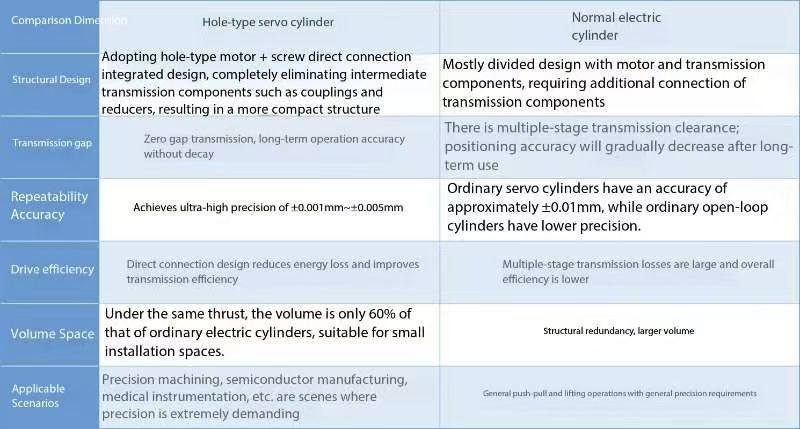
In the field of precision transmission in industrial automation, electric cylinders are the most widely used linear motion actuators. Among them, the bore-type servo electric cylinder, as a high-precision product with optimized structure, differs fundamentally from the standard electric cylinder in design philosophy, performance, and application scenarios. Clarifying these differences is a core prerequisite for industrial selection.
Firstly, from a structural design perspective, their positioning logic is completely different. Standard electric cylinders are general-purpose modular products, typically divided into linear and reciprocating types. Structurally, they follow a basic architecture of servo motor + reduction gear + independent transmission screw + external housing. Their adaptability to installation space leans towards conventional design, requiring pre-set independent mounting flanges or stands for installation. The overall size is formed by stacking the motor, cylinder body, and transmission components, adapting to the installation requirements of most general industrial scenarios. In contrast, the bore-type servo electric cylinder is an embedded, customized product. It adopts an integrated bore-type cylinder design, with the transmission and guiding structures directly embedded in pre-set mounting holes, eliminating additional external mounting structures. Its overall volume is only about 60% of that of a standard electric cylinder with the same thrust. After installation, the overall structure of the device is more compact, specifically designed for compact scenarios requiring embedding within the device body.
The performance differences further highlight their distinct positioning: First, their accuracy differs. Standard servo electric cylinders offer a typical repeatability accuracy of ±0.01~±0.02mm, meeting the accuracy requirements of most general industrial applications. In contrast, the bore-type servo electric cylinder, with its integrated bore structure eliminating assembly gaps, achieves a repeatability accuracy within ±0.005mm, making it more suitable for applications with extremely high precision requirements, such as electronic assembly and medical instruments. Second, their rigidity and stability differ. Standard electric cylinders, designed for various installation scenarios, typically employ a segmented assembly structure, resulting in minute assembly gaps under stress. This can lead to slight accuracy degradation after prolonged high-frequency reciprocating motion. In contrast, the bore-type servo electric cylinder's cylinder body fits perfectly with the mounting hole, increasing overall rigidity by over 30%, resulting in better stability under high-frequency motion and a longer accuracy retention time. Thirdly, their protection adaptability differs. Standard electric cylinders typically have an IP54~IP65 protection rating, suitable for general dusty and humid conditions. However, bore-type servo electric cylinders, due to their fully enclosed structure, can achieve IP67 or even higher protection ratings. Some custom-designed models even support water cooling, making them suitable for harsh environments such as forging and chemical processing.
There are also significant differences in control and maintenance: Standard electric cylinders support multiple control methods, including analog, digital, and bus control, offering flexible selection and a wide cost range. A typical open-loop model costs only about half the price of a bore-type servo electric cylinder, and maintenance is relatively simple; in case of failure, components such as the motor and lead screw can be replaced individually, resulting in low repair costs. Bore-type servo electric cylinders, on the other hand, mostly use closed-loop bus control, supporting multi-axis synchronization and trajectory planning, making them compatible with high-end automation systems. However, due to their integrated design, initial purchase costs are higher, maintenance requires manufacturer cooperation, and the matching requirements for the control system are more stringent.
Finally, from an application perspective, standard electric cylinders have a wider range of applications. They are suitable for general handling, lifting, and general pressing applications where precision requirements are not extreme, offering better cost-effectiveness. In contrast, bore-type servo electric cylinders are better suited for special scenarios with compact space, high precision requirements, and harsh environments, such as joint drive in medical surgical robots, precision positioning of semiconductor wafers, and electrode pressing in new energy batteries, where their structural advantages can be more fully utilized.
When selecting a cylinder, there's no need to blindly pursue high-end bore-type products. For simple push-pull movements, standard electric cylinders are sufficient. For high-precision embedded applications, bore-type servo electric cylinders can be chosen, meeting performance requirements while controlling total lifecycle costs. The above is a 1000-word analysis of the differences; please feel free to suggest modifications if needed.