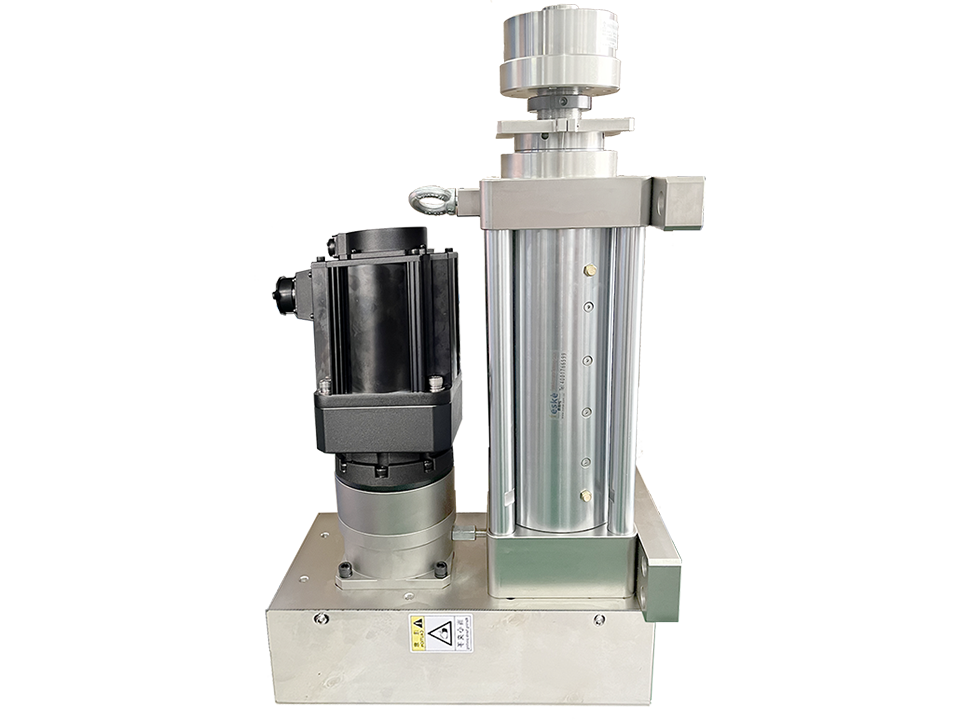
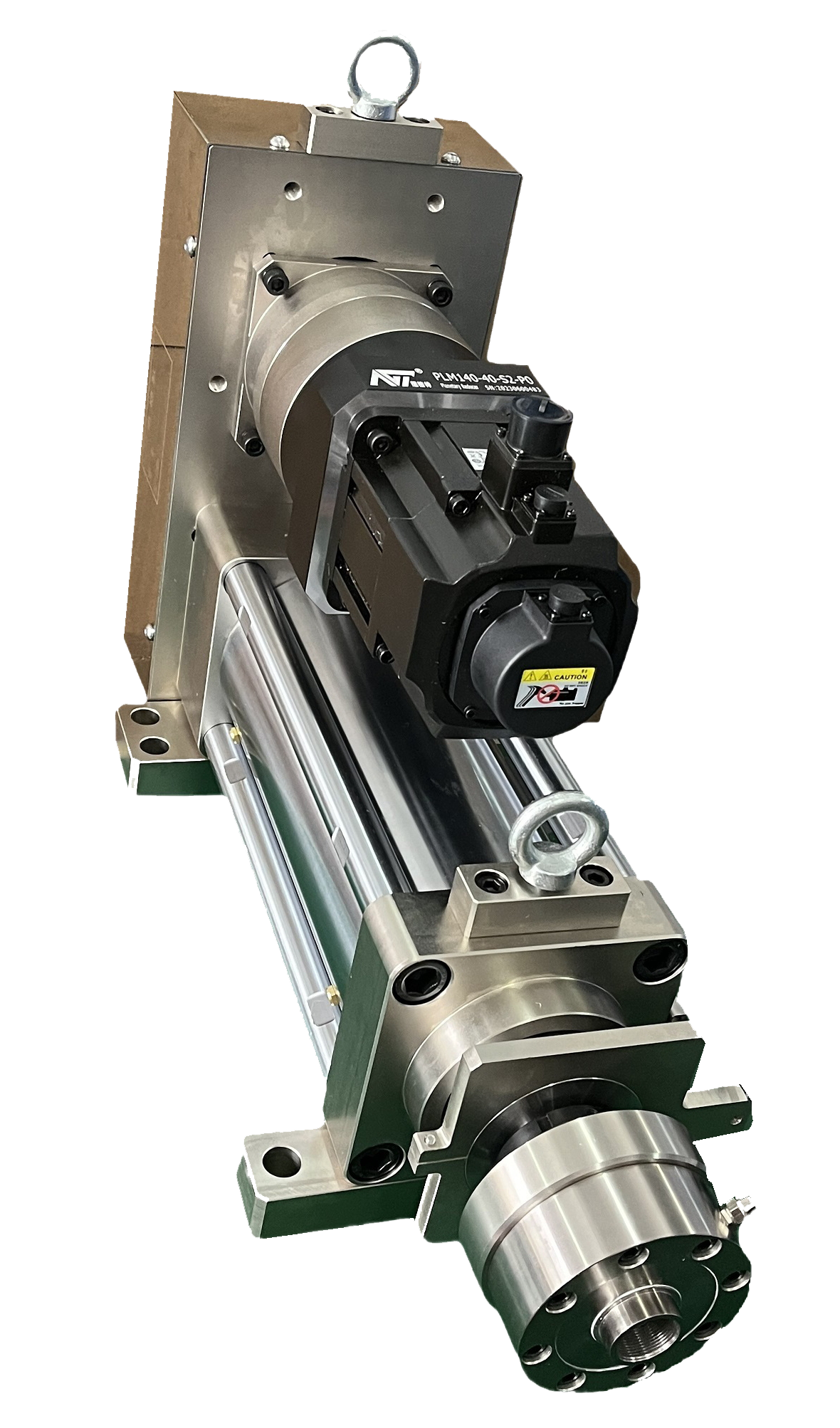
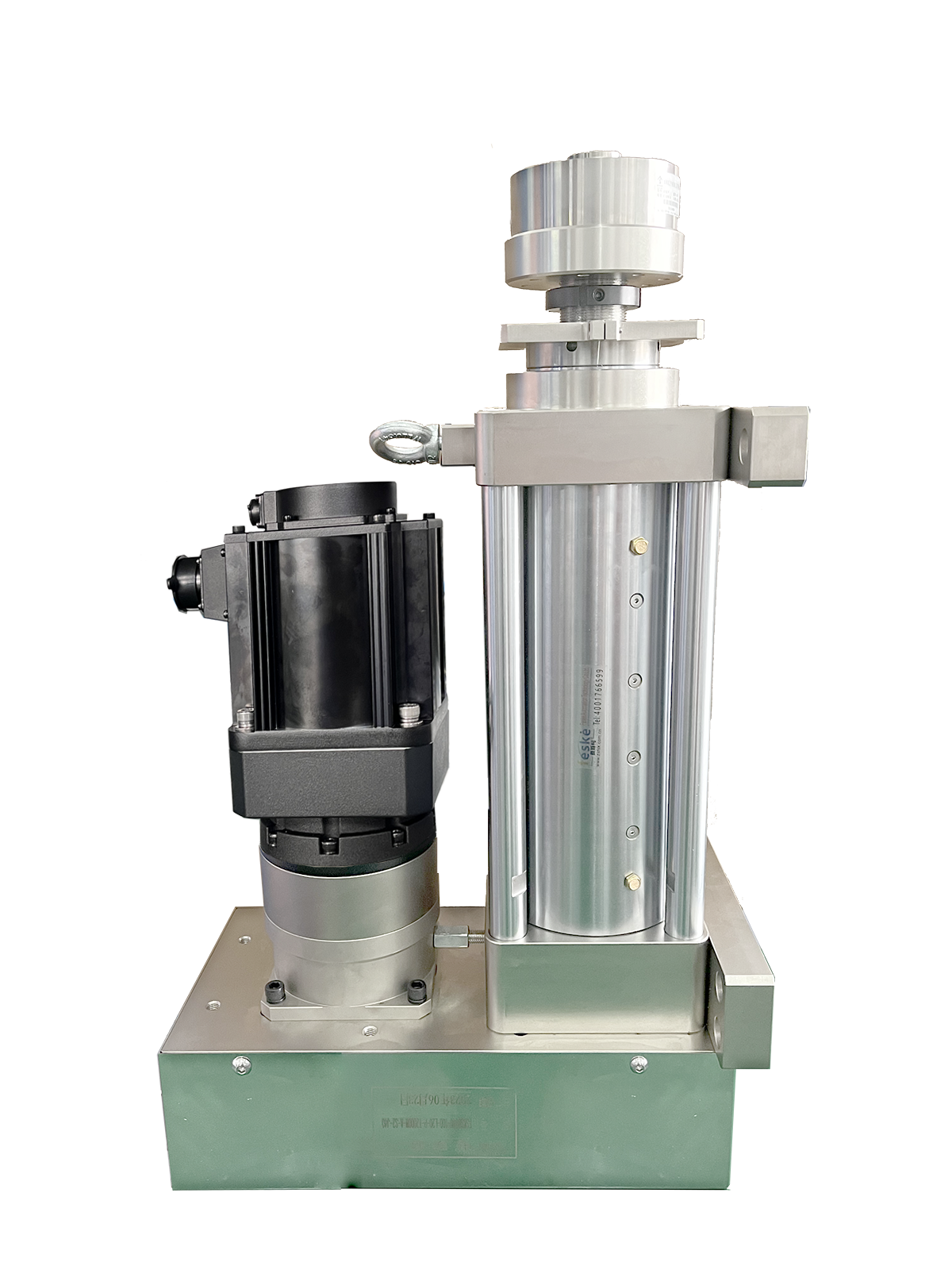
The combination of an electric actuator and an integrated motor drive is a typical example of highly integrated and efficient motion control in modern industrial automation. This type of device highly integrates the motor, driver, and mechanical transmission structure to form a compact, intelligent, plug-and-play linear or rotary execution unit, widely used in precision control scenarios.
I. Core Structure and Working Principle
An electric actuator converts electrical energy into linear or rotary motion through a motor-driven mechanical transmission mechanism. When combined with an integrated motor drive, the drive circuit is directly embedded in the actuator body, eliminating the need for external control cabinet wiring and achieving integrated "drive-control-execution".
Motor Type: Commonly used are servo motors or stepper motors, supporting closed-loop control and possessing high responsiveness and positioning accuracy.
Transmission Method: Mostly uses ball screws or planetary roller screws to efficiently convert the motor's
rotary motion into linear motion, with a transmission efficiency of over 90%.
Integrated Driver: The driver is built-in, supports multiple communication protocols (such as CANopen,
EtherCAT), and can directly receive commands from the host computer to achieve precise control of speed,
position, and torque.
II. Main Advantages
1. Compact Structure: The embedded driver reduces the space occupied by the external control box, making
it suitable for space-constrained equipment.
2. Easy Installation: Plug-and-play design reduces wiring complexity and system integration difficulty.
3. Rapid Response: Zero-distance connection between the driver and the motor ensures low signal transmiss
ion delay and improves dynamic response performance.
4. Low Maintenance Costs: Modular design facilitates fault diagnosis and supports remote monitoring and
parameter adjustment.
III. Typical Application Scenarios
Industrial Automation: Used in assembly lines, handling robots, sorting systems, etc., to achieve precise pos
itioning and high-speed operation.
Medical Equipment: Provides quiet, high-precision motion control in surgical robots and imaging equipment.
Semiconductor Manufacturing: Meets the high cleanliness and high stability motion requirements of cleanroom environments.
New energy equipment: Achieving synergy between force control and position control in lithium battery module press-fitting and photovoltaic module handling.
Maximum horizontal load 10KG
Repeat positioning accuracy: ±0.02 mm
Customizable stroke: 50-1500mm
Screw outer diameter: φ63 mm
Lead: 20 mm
Motor power: 4000W (motor can be customized)
Maximum speed: 50 MM/S
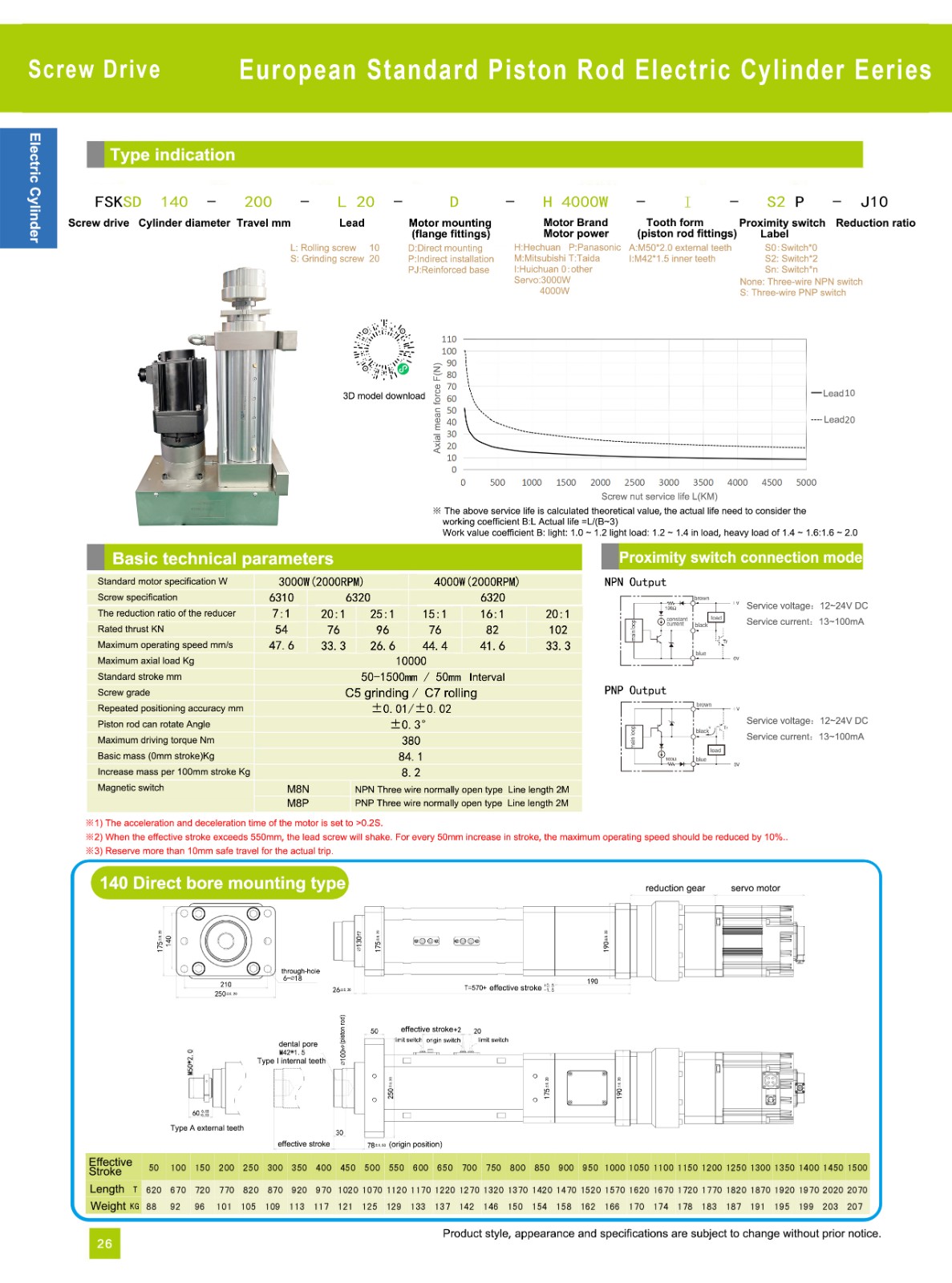
It is a highly integrated mechatronic linear actuator that compactly integrates servo motors, drive controllers and precision mechanical transmission components, significantly reducing the need for external wiring and independent drives, and improving system reliability and space utilization.
1.Electric actuator core features include:
Electric actuator drive and control integration: Electric actuator built-in high-performance servo drives (such as iXC4e enhanced PWM drives), support for brushless DC (BLDC), brushed DC (BDC) and other motor types, Electric actuator can directly receive motion instructions and close-loop control motor operation1;
Electric actuator high-precision motion performance: The current loop and servo loop are digitally closed-loop controlled at a frequency of 20 kHz to ensure that positioning accuracy and repeatability meet industrial-grade precision requirements1;
Electric actuator Scalability and flexibility: Up to 12 coordinated motion axes can be expanded and controlled through the HyperWire® fiber optic bus, suitable for multi-axis linkage scenarios1;
Electric actuator strong environmental adaptability: The operating voltage supports up to 340 VDC, and the peak current capacity reaches 30 A, which can adapt to power fluctuations and high load requirements in industrial environments1.
Its typical applications include industrial automation precision positioning (such as semiconductor equipment), robot joint drive, and Electric actuator mechanical systems that require compact high thrust output, reducing overall costs and failure rates by eliminating external controller dependence.
Discover the next generation of industrial control with our Electric Actuator with Integrated Motor Drive. Designed for seamless integration and unparalleled performance, our electric linear actuator systems are transforming operations across diverse industries. Imagine automating your processes with an electric actuator that offers silent, efficient, and precise linear motion, eliminating the complexities of external motor drives.
Maximum thrust: 20T
Repeat positioning accuracy: ±0.02 mm
Customizable stroke: 50-1500mm
Screw outer diameter: φ63 mm
Lead: 20 mm
Motor power: 5000W (motor can be customized)
Maximum speed: 50 MM/S
Electric telescopic cylinder: intelligent drive, precise telescopic expansion
Electric telescopic cylinder (also known as telescopic cylinder, linear actuator) is a mechanical device that uses electricity as a driving source. The electric telescopic cylinder drives the screw/nut pair or gear rack mechanism through the rotation of the motor to convert the rotary motion into linear reciprocating motion. The electric reciprocating machine integrates the motor, reducer, transmission mechanism and control system. The reciprocating machine can achieve high-precision and high-efficiency automatic telescopic control. The reciprocating machine is widely used in industry, home, medical, agriculture, security and other fields.
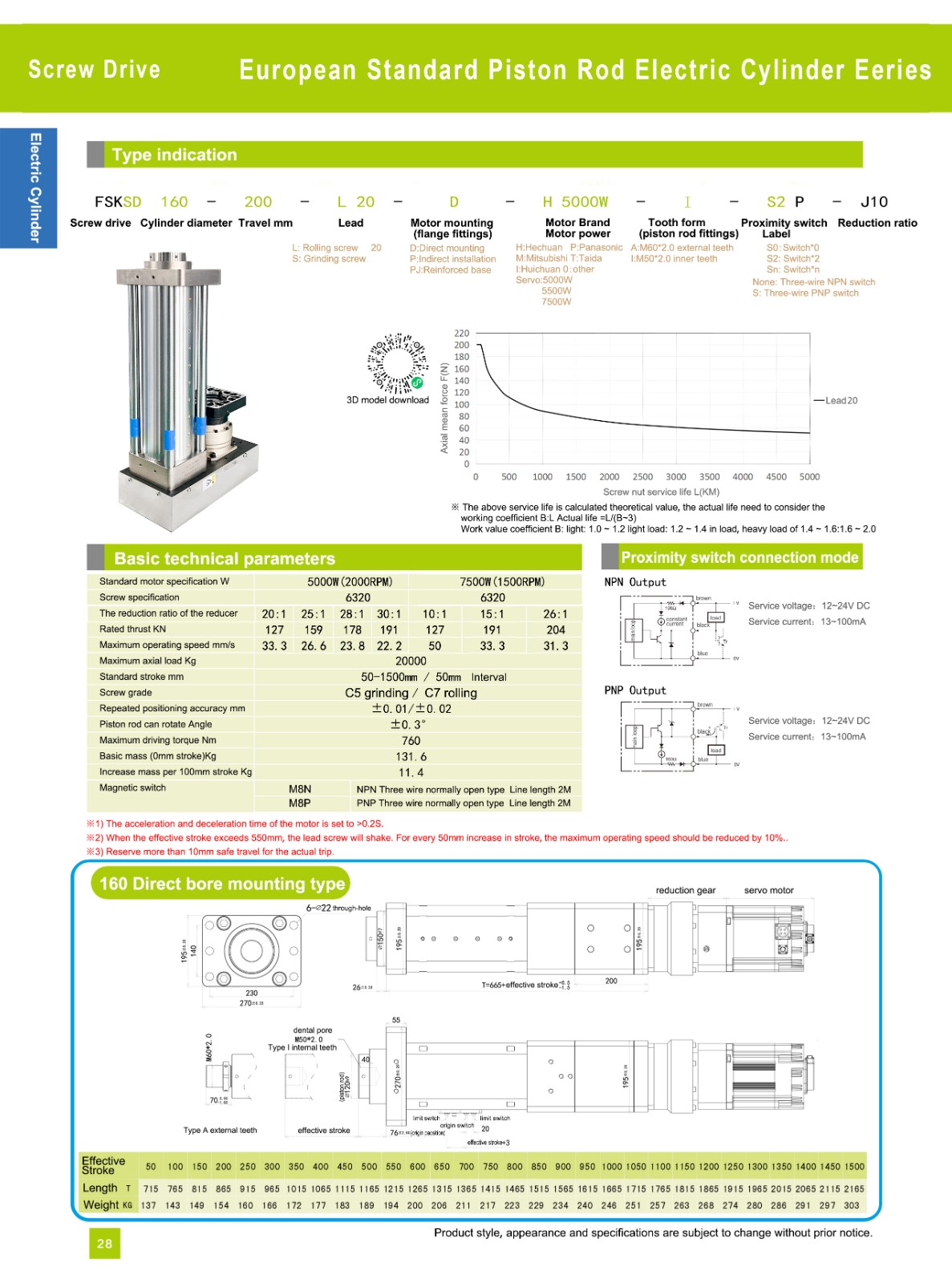
Key advantages of the Electric Reciprocating Machine Telescopic Cylinder FSKSD-140 include:
High Rigidity and High Feed Force
An optimized cross-section design provides excellent force transmission and torque absorption, making
it suitable for high-load applications.
Long-Life Guide System
Internal, double-sided ball bearing ring guides are protected by a permanent magnetic stainless steel
cover strip, significantly enhancing durability.
Various Specifications
Six standard and four wide models are available, ranging in width from 30mm to 220mm, with maxim
um travels of 2.5m (screw-type) or 8.5m (toothed belt type).
Innovative Technology
Independently developed guide technology and a magnetic stainless steel cover strip solution provide a
balance of protection and operational accuracy.
Flexible Adaptability
Can be integrated into mechatronic automation systems, such as gripping and assembly, and supports a
variety of motor and drive configurations.
Electric Reciprocating Machine Telescopic Cylinder is a device that converts rotating motor motion into
linear reciprocating motion. Its core application scenarios include:
1. Heavy equipment and construction machinery
Dump truck/dump truck: Used for lifting cargo containers, replacing traditional hydraulic cylinders, with
higher energy efficiency and precision.
Construction Equipment: Such as forklifts and bulldozers, which can provide up to 100,000 pounds of
thrust and 10 meters of travel
2. Industrial automation and precision manufacturing
Electrochemical Machining (PECM): Used in the manufacture of high-precision metal parts, such as aero
space and medical equipment components
3.
Linear module integration: Combined with the PLC system to achieve precise positioning on the automa
ted production line
Other areas
Material handling: Such as cranes and lifting platforms, supporting semi-automatic operation.
Environmental protection equipment: garbage truck compression device, etc., to reduce hydraulic oil
pollution.
This technology achieves energy saving and low maintenance through electrified design (such as ball
screw transmission), and gradually replaces hydraulic systems
The combination of electric actuators and integrated motor drives enables high-precision, fast-response,
and low-maintenance automated control through the high integration of motors, drive circuits, and
control units. Its core applications include:
1. Industrial Process Control
* Chemical and Refining: Regulating reactor flow valves and controlling pipeline pressure valves, adapting
to explosion-proof and corrosive environments.
* Precision Manufacturing: Servo motors and encoders achieve micron-level positioning, such as in semic
onductor equipment or medical instruments.
2. Automotive Electronics
* Door Modules: Controlling window operation, door lock motors, and rearview mirror adjustment,
supporting PWM and serial interfaces.
* Electric Compressors: Used in electric vehicle HVAC systems to manage battery temperature and cabin
climate.
3. Energy and Aerospace
* Wind Power Generation: Pitch systems adjust blade angles, requiring high-frequency operation and
rapid response.
* Electro-hydraulic Actuators (EHA): Replacing traditional hydraulic systems in aircraft control surfaces,
integrating motor drives and hydraulic pumps, improving efficiency by 30%. 4. Building Automation
Central Air Conditioning: Controls air valves to regulate temperature, resulting in energy savings and
low maintenance costs.
Fire Protection System: Emergency shut-off smoke exhaust valves ensure rapid and reliable operation.
Technical Advantages
High Precision: Vector control technology enables dynamic adjustment.
Environmental Adaptability: IP67 protection rating, suitable for high-temperature, humid, or hazardous
environments.
Energy Saving: Consumes power only during operation, eliminating the risk of hydraulic oil leakage.
Integrated motor-driven electric actuators, through modular design (such as STMicroelectronics' scalable
solutions) and advanced control algorithms (such as PWM technology), have become core components
of modern automation systems.
The combination of an electric actuator and an integrated motor drive is a typical example of highly integra
ted and efficient motion control in modern industrial automation. This type of device highly integrates the
motor, driver, and mechanical transmission structure to form a compact, intelligent, plug-and-play linear or
rotary execution unit, widely used in precision control scenarios.
I. Core Structure and Working Principle
An electric actuator converts electrical energy into linear or rotary motion through a motor-driven mechani
cal transmission mechanism. When combined with an integrated motor drive, the drive circuit is directly
embedded in the actuator body, eliminating the need for external control cabinet wiring and achieving int
egrated "drive-control-execution".
Motor Type: Commonly used are servo motors or stepper motors, supporting closed-loop control and posse
ssing high responsiveness and positioning accuracy.
Transmission Method: Mostly uses ball screws or planetary roller screws to efficiently convert the motor's
rotary motion into linear motion, with a transmission efficiency of over 90%.
Integrated Driver: The driver is built-in, supports multiple communication protocols (such as CANopen, Ethe
rCAT), and can directly receive commands from the host computer to achieve precise control of speed, posi
tion, and torque.
II. Main Advantages
1. Compact Structure: The embedded driver reduces the space occupied by the external control box, making
it suitable for space-constrained equipment.
2. Easy Installation: Plug-and-play design reduces wiring complexity and system integration difficulty.
3. Rapid Response: Zero-distance connection between the driver and the motor ensures low signal transmis
sion delay and improves dynamic response performance.
4. Low Maintenance Costs: Modular design facilitates fault diagnosis and supports remote monitoring and
parameter adjustment.
III. Typical Application Scenarios
Industrial Automation: Used in assembly lines, handling robots, sorting systems, etc., to achieve precise pos
itioning and high-speed operation.
Medical Equipment: Provides quiet, high-precision motion control in surgical robots and imaging equipment.
Semiconductor Manufacturing: Meets the high cleanliness and high stability motion requirements of cleanr
oom environments.
New energy equipment: Achieving synergy between force control and position control in lithium battery
module press-fitting and photovoltaic module handling.
The accuracy of the slide module directly affects the quality of the product.
Using multi-axis electric cylinders reduces labor costs
Widely used in laser welding, laser cutting, glue coating machines, spraying machines, punching machines, dispensing machines, small CNC machine tools, engraving and milling machines, plotters, cutting machines and other conveyors, sorting equipment, applicable testing equipment, educational equipment, etc.
Establish standardized network marketing services and mature technical service management systems around the world to provide dealers and users with high-quality pre-sales, in-sales and after-sales services. During the warranty period, provide users with fast, timely and efficient free maintenance services; outside the warranty period, users will still receive our enthusiastic and thoughtful paid technical services. We always pursue "zero defects in products and 100% customer service satisfaction".